
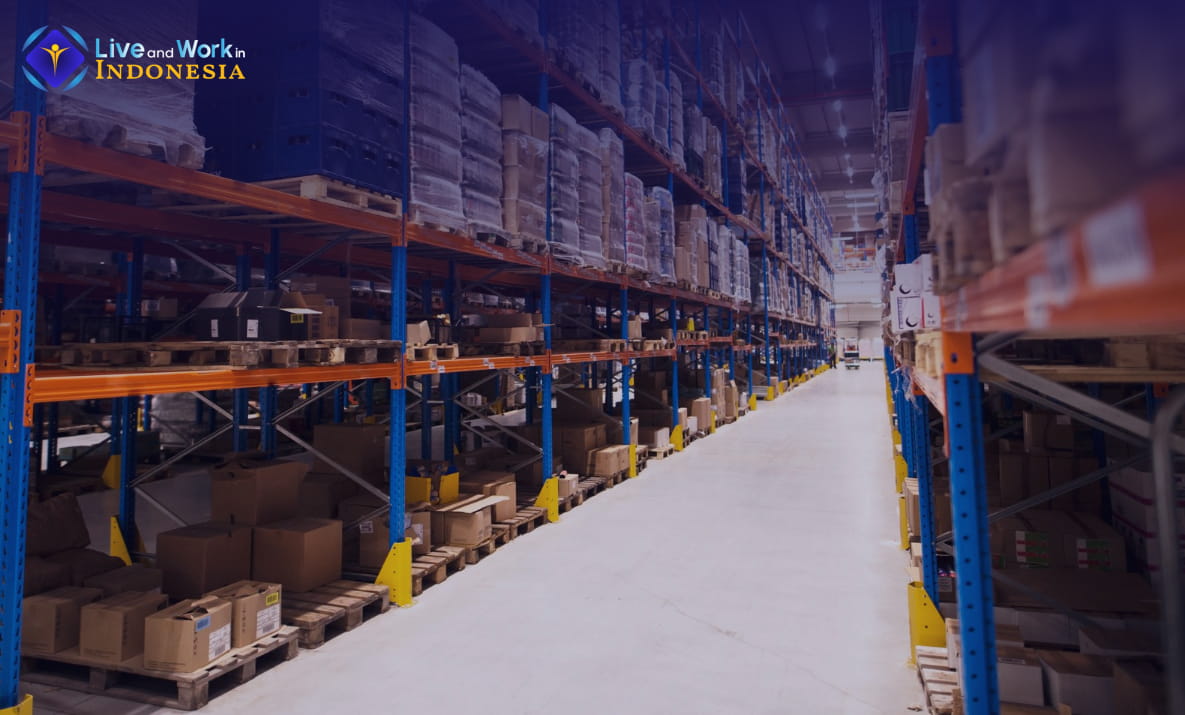
Indonesia’s e-commerce sector has grown into a USD 25 billion industry, and behind every fast delivery, every fulfillment center, and every distribution hub making that possible sits a single regulatory requirement: a valid warehouse license. For foreign investors building logistics, distribution, or manufacturing operations in Indonesia, understanding exactly how warehouse licensing works is not optional groundwork. It is the difference between a facility that operates legally from day one and one that faces seizure, fines, or forced closure.
This guide explains everything a foreign business needs to know about warehouse licensing in Indonesia in 2026: the legal classification system, the documents required, how warehousing connects to broader trading licenses, and the strategic alternative many investors overlook entirely.
What a Warehouse License in Indonesia Actually Covers
The Core License: TDG (Tanda Daftar Gudang)
The primary license required to operate a warehouse in Indonesia is the TDG (Tanda Daftar Gudang), or Registered Warehouse License, issued under the authority of the Ministry of Trade. According to LMI Consultancy’s overview of Indonesian warehouse licensing, the TDG exists to confirm that a warehouse meets environmental safety standards, proper zoning compliance, and structural requirements before it can legally store goods on behalf of its owner or third parties.
The TDG is mandatory for any business operating a warehouse in Indonesia, regardless of company size, and applies whether the facility stores goods for the company’s own operations or functions as a public warehouse, storing commodities on behalf of external clients. Both individuals and legal entities, including corporations, distributors, and manufacturing companies, may apply.
Why TDG Alone Is Rarely Sufficient
A common misconception among foreign investors is treating the TDG as a standalone requirement. In practice, warehouse operations in Indonesia typically require a layered set of licenses working together. A Trading Business License (SIUP) is generally required alongside the TDG if the warehouse supports any trading, distribution, or commercial sales activity rather than purely internal storage. Your company’s Business Identification Number (NIB), issued through the OSS-RBA system, functions as the foundational registration that both the TDG and SIUP applications build upon. For warehouses supporting import or export activity, an Importer Identification Number (API), either API-U for general trading or API-P for manufacturer raw materials, becomes a further requirement layered on top.
Understanding how these licenses interact before construction or lease commitments begin prevents the common scenario where a fully built warehouse sits unable to legally receive goods because one piece of the licensing chain was overlooked.
Indonesia’s Four Warehouse Classifications
Classification Determines Your Compliance Pathway
Under Government Regulation No. 29 of 2021 on Trading Activity, warehouses in Indonesia are classified into four distinct categories based on size and storage capacity. Knowing your classification in advance shapes everything from your TDG application requirements to the scale of safety and environmental documentation you will need to prepare.
| Class | Area | Storage Capacity |
| Class A | 100 m² to 1,000 m² | 360 m³ to 3,600 m³ |
| Class B | 1,000 m² to 2,500 m² | 3,600 m³ to 9,000 m³ |
| Class C | More than 2,500 m² | More than 9,000 m³ |
| Class D | No fixed area specification | 762 m³ or 400 tons (tank or silo form only) |
Class A and B classifications cover the majority of standard closed warehouse facilities used by small to mid-sized distribution and trading operations. Class C applies to large-scale logistics and fulfillment centers, the category most relevant to e-commerce and FMCG operators building significant Indonesian distribution capacity. Class D is reserved specifically for tank or silo storage, relevant to bulk liquid, grain, or chemical storage operations rather than conventional palletized goods.
Step-by-Step: How to Obtain a Warehouse License in Indonesia
Step 1: Confirm Your Legal Entity and KBLI Classification
Before applying for a TDG, your company must already be registered with the Ministry of Law and Human Rights, holding either PT or PT PMA status, and must have selected the correct Indonesian Business Classification Code (KBLI) aligned with warehousing and logistics activities. According to Indonesia’s trade.gov country commercial guide, Indonesia’s shift to the Positive Investment List under Presidential Regulation No. 10 of 2021 opened more than 200 sectors, including logistics, to 100% foreign ownership unless explicitly restricted, making warehousing a generally accessible sector for foreign investors.
Step 2: Secure an Approved Warehouse Location
The warehouse must be situated in an area zoned appropriately for commercial or industrial use under local spatial planning regulations. A location that is technically available for lease but falls outside approved zoning will not pass TDG review, regardless of how well-prepared the rest of your application is. Confirming zoning compliance before signing a lease or purchase agreement is one of the most important early steps in the entire process.
Step 3: Prepare Your Documentation Package
A complete TDG application generally requires a Commercial Enterprise Registration Certificate, your company’s NIB and Business Identification documentation, NPWP (Tax Identification Number), warehouse location details specifying the type, location, and purpose of the facility, the categories of goods to be stored, safety and equipment plans, and proof of the underlying SIUP trading license where the warehouse supports commercial trading activity.
Step 4: Submit Through the OSS System
The TDG application is processed digitally through Indonesia’s Online Single Submission (OSS) system. According to recent guidance on OSS business licensing, standard OSS license processing typically takes 3 to 10 business days, depending on business type and sector, with the application fee for warehouse registration set at IDR 100,000.
Step 5: Receive Your License and Maintain Annual Renewal
Once approved, the TDG is issued digitally and downloadable directly from your OSS dashboard. The license is valid for one year and requires annual renewal. Operating beyond the validity period without renewal exposes the business to administrative sanctions, including potential revocation of the license entirely.
The Strategic Alternative: Bonded Logistics Centers (PLB)
Why Some Investors Bypass Standard Warehousing Entirely
For foreign businesses focused on import-heavy operations, a strategic alternative exists alongside standard warehouse licensing: the Bonded Logistics Center (Pusat Logistik Berikat, or PLB). This government-backed program was introduced specifically to expand Indonesia’s available warehouse capacity while reducing overall logistics costs for businesses moving goods through the country.
A PLB allows imported goods to be stored under a deferred duty and tax regime, meaning import duties and taxes are not immediately payable upon the goods entering the bonded facility. This structure is particularly valuable for businesses managing high-volume inventory awaiting distribution, re-export, or further processing, since it improves cash flow significantly compared to paying duties at the point of arrival.
PLB facilities also support up to 100% foreign ownership, consistent with Indonesia’s broader logistics sector openness, making this a genuinely viable structure for foreign investors building regional distribution hubs rather than purely domestic-facing storage.
Why Warehouse Demand in Indonesia Is Accelerating
The E-Commerce and FMCG Growth Driver
Indonesia’s warehouse and logistics sector has expanded substantially in recent years, with Jakarta emerging as a central hub surrounded by growing industrial parks. The driving force behind this expansion is unmistakable: Indonesia’s e-commerce industry has grown into a market valued at approximately USD 25 billion, creating sustained demand for distribution facilities, fulfillment centers, and third-party logistics (3PL) operations capable of supporting fast, cost-effective delivery to consumers across the archipelago.
Several large Fast Moving Consumer Goods (FMCG) operators have responded by developing built-to-suit warehouse facilities specifically designed for their distribution networks, while the broader PLB program has encouraged a parallel surge in outsourced warehouse logistics, allowing foreign businesses to scale storage and distribution capacity without committing to facility ownership from the outset.
For foreign investors evaluating market entry, this growth trajectory signals two things clearly: warehouse licensing compliance is increasingly scrutinized as the sector scales, and the strategic options available, from standard TDG-licensed facilities to PLB bonded centers to outsourced 3PL partnerships, are more developed and accessible than they were even a few years ago.
Common Compliance Risks Foreign Investors Should Avoid
Operating Before Licensing Is Complete
The most consequential and entirely avoidable mistake is beginning warehouse operations, even informally, before the TDG and any required SIUP are fully issued. Indonesian authorities treat unlicensed warehouse operation as a serious compliance violation, with consequences extending from administrative fines to facility closure and seizure of stored goods.
Misclassifying Warehouse Size
Because TDG classification (A through D) determines the scope of safety and environmental documentation required, underestimating your facility’s actual storage capacity at the application stage can result in approval for the wrong classification. If actual operations later exceed the licensed classification, this creates a compliance gap that surfaces during inspection or renewal, requiring a corrective re-application.
Treating SIUP and TDG as Interchangeable
As outlined earlier, the TDG confirms your warehouse facility meets safety and zoning standards, while the SIUP authorizes the trading activity the warehouse supports. A warehouse used purely for internal company storage with no third-party trading activity may not require a full SIUP, but most commercial logistics and distribution operations require both licenses operating in tandem. Assuming one license covers the function of the other is a frequent and costly misunderstanding.
5 Frequently Asked Questions About Warehouse License in Indonesia
What is the difference between a TDG and a SIUP for warehouse operations? The TDG (Tanda Daftar Gudang) confirms that your physical warehouse facility meets safety, environmental, and zoning standards under Ministry of Trade oversight. The SIUP (Surat Izin Usaha Perdagangan) authorizes the trading and commercial activity the warehouse supports. Most commercial distribution and logistics operations require both licenses simultaneously, since the TDG addresses the facility itself while the SIUP addresses the business activity conducted through it.
Can a foreign-owned company (PT PMA) obtain a warehouse license in Indonesia? Yes. Under Indonesia’s Positive Investment List, logistics and warehousing are generally open to 100% foreign ownership unless your specific business activity falls under an explicitly restricted KBLI classification. A properly registered PT PMA can apply for a TDG through the same OSS process available to domestic companies, provided the underlying company registration, NIB, and NPWP are already in place.
How long does it take to obtain a warehouse license in Indonesia? Standard OSS-processed warehouse licensing typically takes 3 to 10 business days once a complete and accurate documentation package is submitted, including location details, safety plans, and underlying company registration documents. Delays most commonly arise from zoning discrepancies, incomplete equipment or safety documentation, or mismatched classification between the application and actual facility size.
What happens if I operate a warehouse in Indonesia without a valid TDG? Operating an unlicensed warehouse exposes the business to administrative sanctions, which can include fines, suspension of operations, and in serious cases, seizure of goods stored at the facility. Since the TDG must be renewed annually, allowing the license to lapse without renewal carries the same compliance risk as never obtaining one in the first place.
Is a Bonded Logistics Center (PLB) a better option than a standard warehouse license? It depends on your business model. A PLB offers significant cash flow advantages for high-volume import operations through deferred duty and tax payment, and supports full foreign ownership. However, standard TDG-licensed warehouses remain the more straightforward and widely used option for domestic-focused distribution, retail support, or manufacturing storage that does not center heavily on bonded import flows. Evaluating your specific import volume and cash flow priorities against each structure is essential before committing to either path.
Build Your Indonesian Warehouse Operation on Solid Legal Ground
Indonesia’s logistics and warehousing sector is expanding rapidly, and the regulatory framework governing it, from TDG classification to the strategic flexibility of PLB bonded centers, has matured alongside that growth. Getting your warehouse license structured correctly from the outset protects your facility, your inventory, and your broader Indonesian operations from the costly disruptions that come with licensing gaps.
Live and Work Indonesia provides complete warehouse licensing support for foreign investors, covering TDG application and classification guidance, SIUP coordination, KBLI verification, and strategic advisory on whether a standard warehouse license or a Bonded Logistics Center structure best fits your logistics model.













