
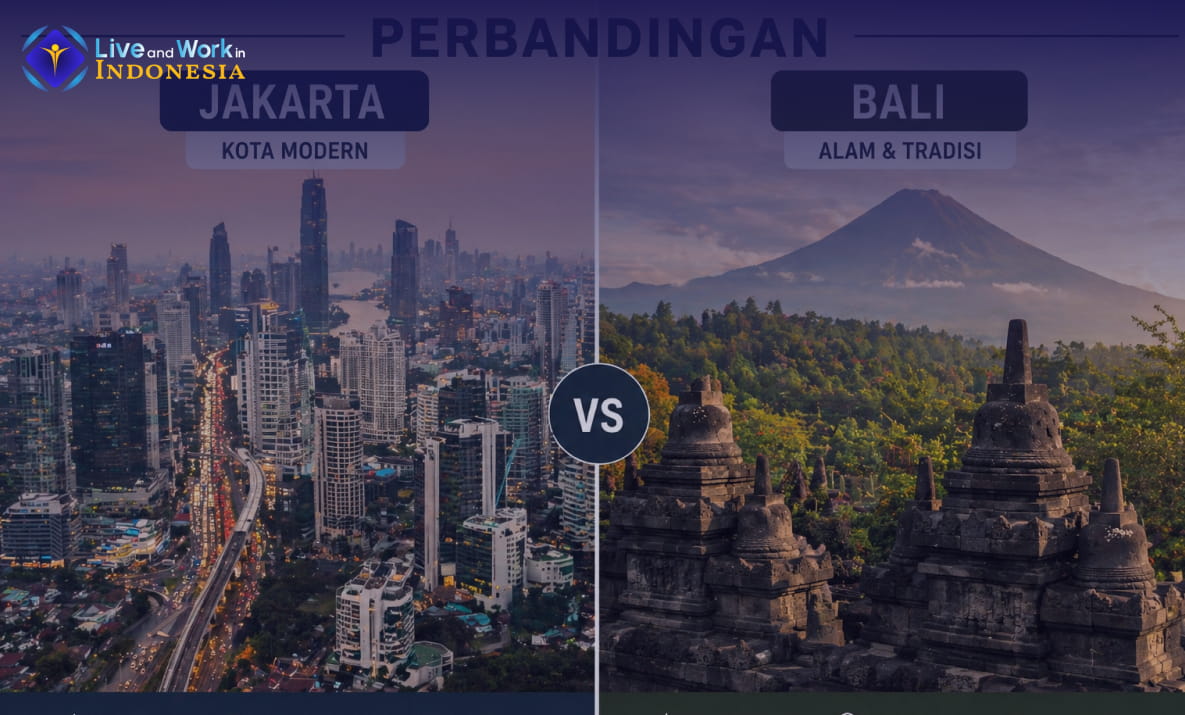
The decision to expand a global business into the Indonesian archipelago is one of the most lucrative macro moves available to international brands in 2026. As Southeast Asia’s undisputed economic powerhouse, Indonesia presents a thriving market of over 280 million consumers, an expanding digital infrastructure, and a robust investment climate. For many multinational enterprises, jumping straight into a high-capital corporate subsidiary like a PT PMA is premature. Instead, choosing to establish a Kantor Perwakilan Perusahaan Asing (KPPA) serves as a sophisticated, zero-capital entry strategy. However, once you choose the vehicle, you face a critical geographical dilemma: Representative Office Setup Jakarta vs Bali.
Both regions offer vastly different structural ecosystems, lifestyle incentives, and commercial networks. While one serves as the undisputed financial and political command center of the nation, the other has matured into a global hub for tech innovation, hospitality, and the creative digital economy. This guide provides an exhaustive, comparative analysis across both locations to ensure your corporate expansion aligns perfectly with your long-term commercial goals.
1. Understanding the Baseline Legal Structure in 2026
Regardless of whether your expansion points toward the skyscrapers of Java or the commercial enclaves of the Lesser Sunda Islands, the legal foundation of a representative office remains uniform under national law.
The Power of Zero Capital Barriers
The primary benefit of a KPPA is that it features no minimum capital requirement. Unlike a full corporate subsidiary, which demands a long-term investment plan of IDR 10 billion and an immediate liquid paid-up capital of IDR 2.5 billion, a representative office can be established without major upfront funding. It is a non-revenue-generating structure designed strictly to act as a liaison, marketing, and market research arm for an offshore parent entity.
Risk-Based Portal Integration
The entire application process runs smoothly through the OSS-RBA (Online Single Submission Risk-Based Approach) system. Because a general representative office does not engage in direct commercial sales or local invoicing, it is categorized as a low-risk entity. This allows the digital portal to bypass intensive technical ministerial verifications, issuing your Nomor Induk Berusaha (NIB) or Business Identification Number within 10 to 14 business days, provided your parent corporate documents are correctly apostilled.
2. Choosing Jakarta: The Corporate and Institutional Command Center
When evaluating a Representative Office Setup Jakarta vs Bali, your sector’s reliance on institutional networks, B2B partnerships, and heavy industry oversight is the deciding factor.
Access to Technical Ministries and BKPM Headquarters
Jakarta remains the absolute center of gravity for corporate law, diplomacy, and macroeconomic policy. Although the political administration is actively transitioning to Nusantara (IKN), the central administrative apparatus, national tax boards, and the Indonesia Investment Coordinating Board (BKPM) maintain their core operational headquarters in the capital. Having your Chief Representative Officer (CRO) physically situated in the Golden Triangle (Sudirman, Thamrin, Kuningan) allows for instant, face-to-face engagement with state regulators, diplomatic trade missions, and major industry associations.
Proximity to Enterprise B2B Networks and Logistics
If your parent organization operates in heavy manufacturing, supply-chain logistics, corporate fintech, or large-scale commodities, Jakarta is the only logical choice. The capital provides direct access to the nation’s premier deep-water ports, dense industrial corridors in West Java, and the corporate headquarters of the largest domestic conglomerates. A presence here signals corporate maturity and institutional stability to your local enterprise partners.
3. Choosing Bali: The Epicenter of Tech-Nomadism and Agritech
Conversely, looking at a Representative Office Setup Jakarta vs Bali through the lens of modern digital platforms, high-end hospitality, and wellness consulting reveals why the Island of the Gods is no longer merely a tourism destination.
The Shift to Creative Hubs and Digital Infrastructure
In 2026, Bali has completed its transformation into Southeast Asia’s premier green-tech and creative innovation hub. Backed by world-class co-working networks in Canggu, Ubud, and Sanur, alongside a highly advanced decentralized fiber-optic grid, the island has attracted an elite density of international tech talent, sustainable software developers, and green infrastructure investors.
Ideal for Consumer Feasibility and Agritech Sourcing
For foreign companies whose primary goal is to conduct consumer market research for lifestyle brands, eco-hospitality operations, or sustainable agritech distribution, Bali provides a highly concentrated, international demographic testing ground. Furthermore, if your parent company’s objective is to monitor quality control and oversee the supply chain logistics of artisanal goods or premium agricultural exports, placing your liaison office closer to the agricultural fields of eastern Indonesia is structurally optimal.
4. Domicile Requirements and Cost Realities
Your choice of location dictates your early-stage operational runway burn rates and your physical office lease compliance parameters.
Virtual Office Solutions in Jakarta
In Jakarta, zoning regulations are strictly corporate. Every representative office must be situated within a recognized commercial zoning area. To maintain flexibility, many foreign corporations utilize premium Virtual Office structures in prestigious office towers in South or Central Jakarta. This satisfies the legal requirements for the OSS portal and automated tax validations at a highly predictable, minimized cost baseline.
Creative Workspaces and Physical Footprints in Bali
In Bali, zoning codes vary significantly by regency (such as Badung or Gianyar). While virtual offices are legally accepted for digital consultancies and software researchers, companies looking to secure technical or sourcing licenses frequently find that local authorities demand a physical office or dedicated co-working desk allotment. Fortunately, Bali’s premium commercial rental market offers flexible, design-driven workspaces that blend corporate professionalism with an inspiring environment.
5. Immigration and the Chief Representative Officer (CRO) Visa
To legally lead your chosen branch on the ground, your company must appoint a CRO. This individual represents the corporate interests of your offshore headquarters.
The Working KITAS Framework
If your firm chooses an international executive as the local head, the office must sponsor a standard Work KITAS (index E23). Under the current labor guidelines enforced by the Ministry of Manpower, the CRO must demonstrate clear professional credentials, an authenticated university diploma, and a clean professional background. The representative office must also pay the mandatory DKP-TKA (Foreign Worker Compensation Fund) fee of USD 1,200 annually.
Lifestyle vs. Corporate Logistics
When analyzing Representative Office Setup Jakarta vs Bali for your foreign personnel, talent retention is a critical variable. While Jakarta offers high-end urban living, premium international schools, and seamless regional flight connections via Soekarno-Hatta International Airport, Bali offers an unparalleled lifestyle advantage that makes it highly attractive for international tech founders, creative directors, and research teams looking to balance deep work with personal wellness.
6. Fiscal Realities under the CoreTax Network
A common legal mistake made by foreign investors is assuming that a non-profit representative office completely escapes the eyes of the tax collector. In 2026, all operations are completely visible within the centralized CoreTax digital administration dashboard.
Every operational transfer sent from your global account to fund local office operations is tracked automatically. Your administrative team must cleanly process monthly withholding taxes on employee salaries (PPh 21) and office space leases (PPh 4(2)). Furthermore, your entity must submit a mandatory Investment Activity Report (LKPM) every semester (twice a year) to the BKPM, proving that your activities remain strictly non-commercial.
To manage these complex, overlapping business licensing and payroll frameworks smoothly without running into localized administrative deadlocks, smart companies work alongside local market leaders. Utilizing the legal, tax, and corporate setup infrastructure managed by Live and Work Indonesia guarantees that your market entry remains structurally sound and 100% compliant with current 2026 government codes.
5 Frequently Asked Questions (FAQ)
1. Can a Representative Office in Bali sign commercial sales contracts?
No. Regardless of location, a KPPA is strictly a non-revenue-generating vehicle. Any commercial transactions, direct sales, or invoicing must be executed and signed directly by your offshore parent organization.
2. Can I use a residential villa in Bali as my corporate domicile?
No. The OSS-RBA system will automatically reject any address categorized under residential zoning. Your representative office must have a legal commercial address, which can be achieved through a certified Virtual Office or a commercial workspace building.
3. How long does the registration take for Jakarta vs Bali?
The legal NIB issuance via the OSS-RBA portal takes 10 to 14 business days for both locations. However, local tax office (KPP) validation and physical workspace checks can occasionally take an extra 3 to 5 days in Bali due to decentralized administrative routing.
4. Is an annual corporate tax return mandatory for a liaison office?
Yes. Every entity holding an Indonesian corporate tax ID (NPWP) must submit an Annual Corporate Income Tax Return by April 30th of the following year, declaring a “Nil” or zero-revenue status alongside their itemized administrative spend summaries.
5. Can a Representative Office be converted into a PT PMA later?
You cannot directly convert or upgrade the license. When your market research phase is complete and you are ready to trade commercially, you must incorporate a new PT PMA subsidiary through the OSS system and formally close the representative office.
Conclusion: Aligning Destination with Corporate Strategy
When deciding on a Representative Office Setup Jakarta vs Bali, there is no singular superior location only the location that accurately mirrors your corporate objectives.
If your corporate strategy demands instant proximity to technical ministries, large-scale financial institutions, global embassies, and heavy industrial supply chains, Jakarta remains the uncontested destination. However, if your brand is focused on software innovation, digital design, lifestyle branding, agritech sourcing, or eco-conscious development, Bali provides an unmatched collaborative ecosystem and a powerful talent magnet.
Understand your operational boundaries, respect local zoning regulations, and leverage the country’s streamlined digital pipelines to secure a highly compliant, long-term foothold in Southeast Asia’s most vibrant economy.













